Where we are, where we're headed, and what we will never build. Every release has a codename, a ship target, and a vote-on-this link so you can push the order of work. Dates are intent, not promise. This is a solo project with a real day job. If you want something faster, send a PR.
The current release is v3.2.1. The cards after it are the plan as written in May 2026, kept for the record; the changelog lists what shipped.
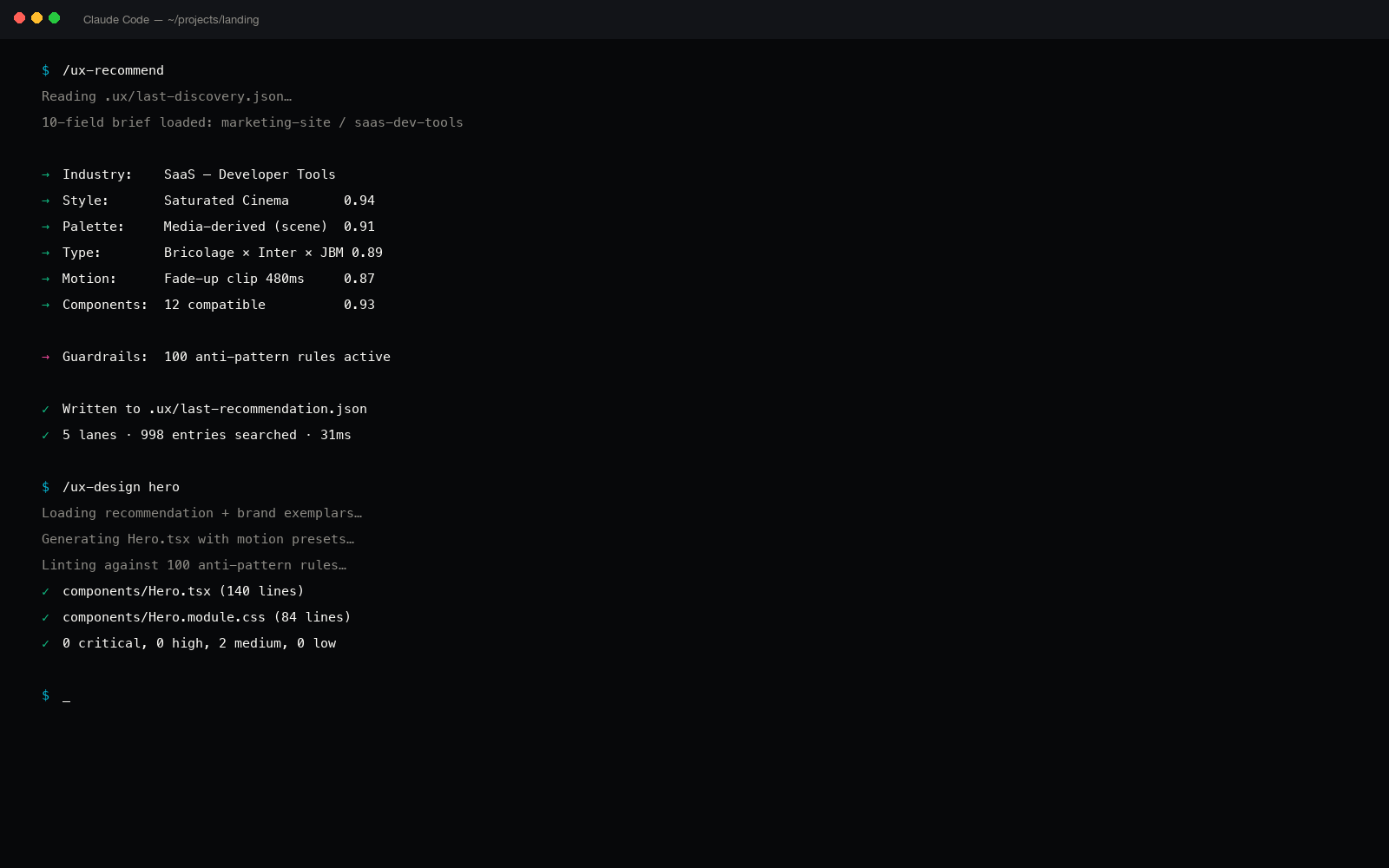
Where v3 stands today: brief to recommendation to linted component, in one Claude Code session.
Releases
v3.2.1"Sees the Page"
Shipped · 2026-09-24
Now: the linter looks at the rendered page.
Some layout failures only exist after the browser lays the page out. v3.2 adds an opt-in render check that measures them, and v3.2.1 makes the MCP server start again on a fresh install.
What's in v3.2
Render check: uxskill lint --render loads every HTML file in headless Chromium at 390, 430, 768 and 1280 px, in LTR and RTL, and reports centered text whose box sits off center and pages that scroll sideways, with the source line
New lint rule: decorative-accent-ruler flags a short 1 to 2 px line used as ornament
Fixed: placeholder-token-shipped no longer fires on ordinary JSX style objects
MCP starts again (v3.2.1): the dependency is now mcp>=1.10,<2, and CI builds the real server
May 2026: the engine, the manifests, the linter, the IDE bridge.
Everything ux-skill is named after. The Python engine reads nine manifests, the 5-parallel-search recommender returns a structured plan, the 22 slash-commands run inside Claude Code / Cursor / Windsurf / 14 other adapters, and the anti-slop linter blocks 35 fingerprints from ever reaching git add.
Deepen the linter. Cross-wire the manifests. Add landing-patterns.
v2.0 ships with 35 rules. v2.1 doubles down: 17 more rules pulled directly from the audit of the 50 landing pages I shipped this year that the model defaulted into something generic. Plus a new landing-patterns.yaml manifest with the 28 patterns we keep needing (hero variants, pricing variants, testimonial variants) and cross-reference wiring so a chosen brand auto-narrows the available components.
Key features
+17 anti-pattern rules: pulled from the May 2026 audit of 50 generic landings (grep findings: 14 purple gradients, 11 three-tier cards, 9 default-Inter pairs, 16 generic feature-icon grids)
Localize the README. Add an MCP server. Bridge to Figma.
Open-design hit 54k stars partly because the README ships in 11 locales. ux-skill is currently English-only and that's a real disadvantage in MENA, China, Japan, Korea, Brazil. v2.2 fixes that. It also adds an MCP server so cross-tool memory (Cursor remembers what Claude Code generated yesterday) is real, and a Figma MCP bridge so design-token import becomes one command.
Key features
README in 11 locales: English, Arabic, Spanish, Portuguese, French, German, Russian, Chinese (Simplified), Japanese, Korean, Hindi
MCP server (uxskill-mcp): stateful memory of prior designs across Claude Code, Cursor, Windsurf sessions; canonical brand persists per-repo
Figma MCP bridge: pull tokens from a Figma file into a brand spec; one-way sync; design system import in under 30 seconds
RTL pass: every command flag-tested under dir="rtl"; mirrored animation contracts in motion-engineer agent
Brand pack #2: 28 MENA + APAC brands added to the brand library (Careem, Talabat, Noon, Aramex, GO-JEK, Grab, Lazada, +21)
Hi-fi prototype output. Local preview server. Motion MP4 export.
huashu-design ships hi-fi prototype output and that's the only dimension where they outscore us. v2.3 closes it. We add a hi-fi mode that emits real component code (React, Vue, Svelte, vanilla) with frame-accurate motion specs, a local preview server on :4242 that watches and re-renders, and MP4 export of every motion spec so you can drop it in a deck.
Key features
Hi-fi output mode: /ux-design --fidelity hi emits production component code in React, Vue, Svelte, vanilla TS
Local preview server: npx uxskill preview opens http://localhost:4242 with hot-reload of every generated artifact
Motion MP4 export: every /ux-motion spec exports a 4-second loop MP4 + WebM for decks and docs
Component library export: generated systems compile to a publishable npm package on demand
Frame-accurate motion engine: sub-16ms GSAP timeline export; cubic-bezier per axis; no ease-in-out defaults
Real-time live preview. Image-to-code reverse bridge. Multi-language gen.
The 1.0 of the next phase. Real-time means the preview server is no longer file-watched; the AI agent streams component diffs into the open browser tab as it generates. Image-to-code closes the loop: paste a screenshot of someone else's UI, get a ux-skill-clean rebuild of it (with the slop detected and removed). Multi-language adds Swift, Kotlin, and Flutter generators so the same brand spec lints native too.
Key features
Real-time live preview: agent streams diffs; preview repaints sub-second; no file-watch latency
Image-to-code bridge: paste a UI screenshot, get a brand-clean React + Tailwind rebuild with anti-pattern annotations
Discipline shows in what you refuse. These are not "not yet" items. They are permanent no's. If a v3.5 ever ships any of these, I owe the community a public retraction.
Hosted SaaSThe whole point is that the engine runs on your machine. No remote server, no quota, no rate limit.
Paid tiersNo Pro plan, no premium brand pack, no commercial license. The manifest must stay open.
Account systemNothing to sign up for. Ever. The CLI does not authenticate against any service.
TelemetryNo usage events, no error reporting, no anonymous IDs. Bug reports come from humans via GitHub.
AI image generationux-skill recommends; it does not synthesize. We will not call Midjourney or DALL-E from the CLI.
Video generationSame. We may export specs to MP4 (v2.3) but we will never generate video content via a model.
Built-in analyticsWe don't measure user behavior in your repo. The linter reports what's there; that's the only signal.
Vendor-specific lock-inNo "ux-skill only works in Claude Code." Every adapter ships at parity. Cursor and Windsurf are not second-class.